JARVIS · Iron Man
JARVIS inspired my vision of a personal assistant that can communicate naturally, understand what I need, and help me work through real tasks.
A JARVIS-inspired personal AI command center. Memory, voice, agents and your connected world—designed around your decisions.
VERIFIED MILESTONE / OCTOBER 24, 2026
VISION / ENGINEERING ROADMAP
Project Brain explores local-first personal intelligence with persistent memory, conversational voice, supervised tools and private integrations. The current local implementation has not yet been independently audited, so this page distinguishes design direction from verified features.
00 / THE INSPIRATION
JARVIS inspired my vision of a personal assistant that can communicate naturally, understand what I need, and help me work through real tasks.
Transcendence inspired me to explore advanced AI, interconnected systems, continuous learning, and the possibilities of digital intelligence.
My long-term goal is to bring memory, voice, reasoning, AI agents and secure automation into one personal intelligence system—with privacy, human control and measurable progress at its foundation.
00 / SYSTEM ARCHITECTURE
01 / SYSTEM DESIGN
Local SQLite for structured facts and tasks, searchable embeddings for relevant notes, source references, and edit/delete controls.
First deliverable: Explicit save, search, update and forget actions; no silent accumulation.
Start with a streaming text chat, then add push-to-talk transcription and spoken replies. Consider offline speech engines before optional cloud providers.
First deliverable: Reliable text interface and microphone opt-in before wake-word experiments.
Planner proposes steps; a typed tool registry executes narrowly scoped operations; every sensitive action requires an explicit confirmation.
First deliverable: Read-only tools and safe task drafting; no unattended sending, deletion or deployment.
Connect calendars, notes and approved project APIs with independently scoped permissions; use read-only access first.
First deliverable: Local project registry, then a single opt-in connector.
Local-first storage, least privilege, encrypted secrets, approval gates, audit logs, explicit retention and account isolation.
First deliverable: Threat model, credential boundary, audit log and visible revoke controls.
Responsive chat, memory inspection, task queue, tool approvals, project graph and activity history with keyboard and screen-reader support.
First deliverable: Minimal chat + task pane with clear source and action statuses.
02 / DEVELOPMENT ROADMAP
Inspect Documents/solomon-ai, dependencies, local data flow, executed tests and working features. Record evidence before making public technical claims.
Acceptance check: A reproducible run guide and feature inventory.
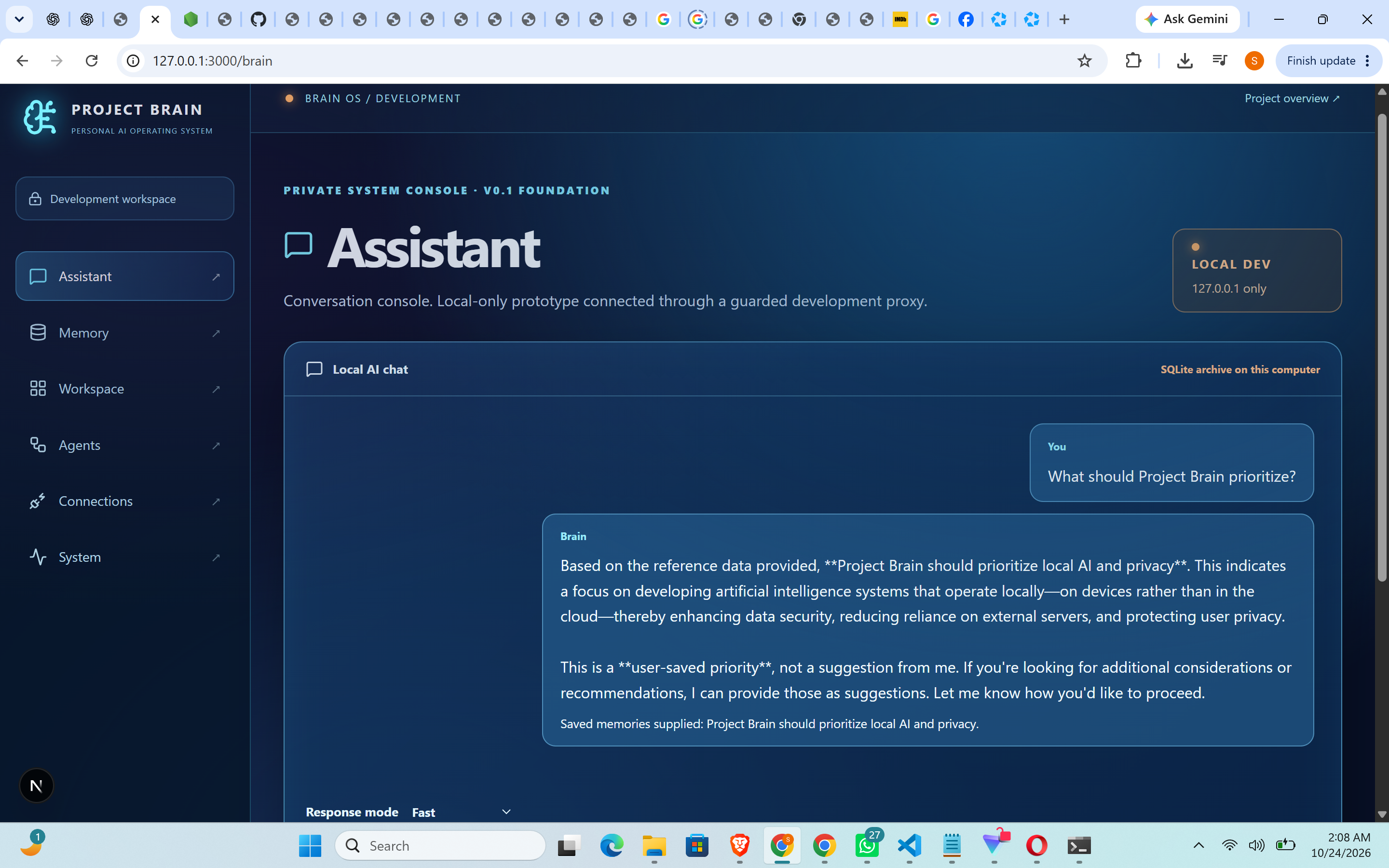
Local chat UI, selectable local model through Ollama, session history, controlled prompts and basic logs.
Acceptance check: Repeatable conversation test with no cloud dependency required for the core path.
SQLite entities and tasks, explicit memory-saving flow, retrieval with citations, edit/export/delete interface.
Acceptance check: Demonstrate save → retrieve → correct → delete end-to-end.
Opt-in speech-to-text and text-to-speech, push-to-talk controls, transcription review and interruption handling.
Acceptance check: Voice round-trip with microphone permission and privacy indicators.
Task planner, deterministic tools, dry-run previews, approve/deny UI, execution receipts and audit trail.
Acceptance check: Prove disallowed actions cannot run without owner confirmation.
Read-only integration with one authorized project or service; minimal data sync, token rotation and disconnect.
Acceptance check: Integration operates with revoked or missing permission safely.
Tests, evaluation scenarios, accessibility, backups, resource limits and observability; measure latency and memory retrieval quality.
Acceptance check: Documented acceptance suite and safe rollback.
03 / SECURITY PRINCIPLES
Brain should show what it knows, why a tool needs access, what it intends to do, and how to undo or revoke access. No hidden external actions, no background microphone capture, and no unrestricted access to local files.
WHAT COMES NEXT
The next engineering step is a private local-code audit: identify what already works, document the startup process, then implement the smallest end-to-end assistant slice. Once verified, this page can display genuine demos, implementation milestones and source-backed evidence.
Back to all projects →